
How to Find St. Tammany Parish Arrest Records
The St. Tammany Parish Sheriff's Office runs the official inmate booking portal, which is the first stop for recent arrests. The roster shows people currently or recently booked into the parish jail. Search by name, then confirm the right person by age, booking date, or charge.
Arrest data at booking is preliminary. Charges can change, get refused, or be dismissed once prosecutors and the court review the case. Treat a booking entry as a starting point, not a final outcome.
- Open the official Sheriff inmate roster.
- Search by last name, then first name, and try alternate spellings.
- Match the result by booking date, age, charge, or arresting agency.
- Open the detail page if the portal offers one.
- Confirm custody or release status with the jail when timing matters.
The Clerk's criminal department keeps the filed court side of these cases, and its page explains how criminal filings are handled.
The Clerk's criminal department page covers filings, bills of information, and criminal record handling for St. Tammany Parish.
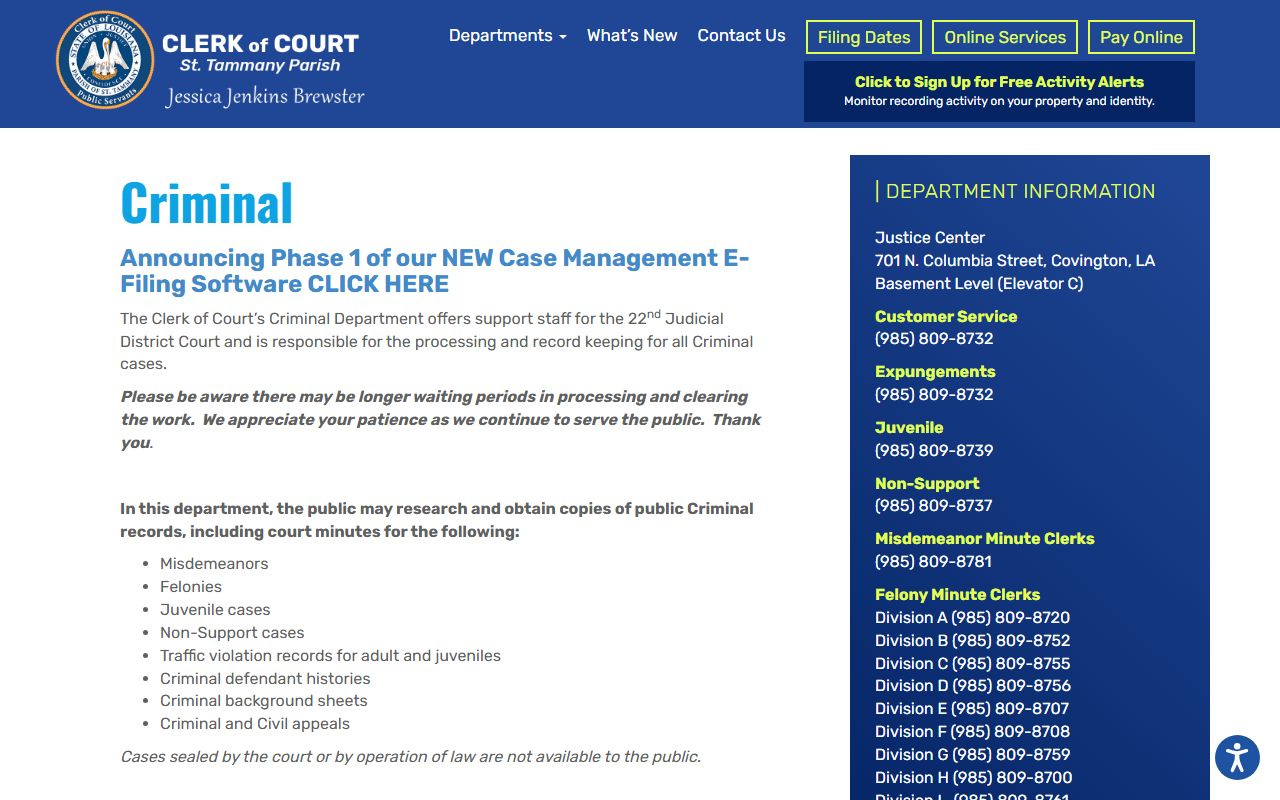
That office holds the court file, while the Sheriff holds the booking record, so a full criminal history pulls from both.
Arrest Record vs Criminal Court Record
An arrest record and a criminal court record are two different files held by two different offices. The Sheriff creates the arrest and booking record. The Clerk and the district court hold the prosecution and case record. One shows custody, the other shows the legal outcome.
| Feature | Arrest Record | Criminal Court Record |
|---|---|---|
| Created by | Sheriff's Office at booking | Clerk and 22nd JDC |
| Shows | Booking, charges, custody status | Charges, pleas, sentence, disposition |
| Best source | Inmate roster | Clerk case search |
| Proves guilt | No | Only on conviction |
For the case outcome, use the St. Tammany Parish court records page. For who is in custody now, use the inmate records page.
St. Tammany Parish Sheriff Booking Records
After an arrest, a person is taken to the jail, searched, medically screened, photographed, and fingerprinted. Charges, warrants, and holds are reviewed, and bond status is set or considered. Louisiana law calls for a prompt first appearance, but timing depends on the arrest time, the charge, and court availability.
A booking record can include the booking number, the booking date, the arresting agency, the charges, the bond amount, and any holds. A mugshot may appear depending on how the roster displays results. Personal property is inventoried and stored during the stay.
A "hold" can block release even when a local bond is posted, because the hold may come from another parish, the state, probation, or a federal agency.
After booking, the case moves toward prosecution. The 22nd Judicial District Attorney decides whether to file charges, what to file, or whether to refuse the matter. That decision can differ from the charge listed at booking, which is why the court file, not the arrest record, shows the real charges a person faces. Diversion or a specialty court may also change the path of a case before it reaches a plea or trial.
What St. Tammany Parish Arrest Records Show
A booking entry on the roster carries a set of standard fields. The exact display depends on the portal, and some fields appear only when the data is public. The table lists what a typical St. Tammany Parish arrest record shows once you open a result.
| Field | What It Shows |
|---|---|
| Full Name | The booked person's legal name, with aliases where listed. |
| Booking Number | The unique identifier for the booking event. |
| Booking Date | The date and time the person entered custody. |
| Arresting Agency | The agency that made the arrest. |
| Charges | The alleged offenses, with statute or description. |
| Bond | The bond amount and type by charge. |
| Custody Status | Whether the person is held, released, or transferred. |
Booking data is not proof of guilt. A "booked" status only means the Sheriff processed the person into custody.
Mugshots and Background Checks
A mugshot may appear on a booking record, but its presence varies by display and policy. A booking photo records how a person looked at intake, not a finding of guilt. Use it to confirm identity, not to judge a case.
For a formal background check, the Sheriff's Office offers a criminal history record for a fee. A standard report runs $25.00, and a notarized version runs $40.00. These are different from the free roster view and from a certified court record at the Clerk. Private background sites are not official and often lag the real record.
Charges vs Convictions in St. Tammany Parish Records
The difference between a charge and a conviction is the heart of reading any criminal record. A charge is an allegation at booking or in a filing. A conviction is a finding or plea of guilt entered by the court. Many charges never become convictions.
| Point | Charge | Conviction |
|---|---|---|
| Meaning | An accusation, not proof | A court finding or plea of guilt |
| Where it appears | Booking and charging documents | Court disposition and sentence |
| Can change | Amended, refused, or dismissed | Stands unless appealed or vacated |
Warrants and Capias in Criminal Cases
Some arrests start with a warrant, and some court actions create one. An arrest warrant issues on probable cause. A bench warrant or capias issues from a judge, often after a missed court date. Booking records may list a warrant number when an arrest was made on a warrant.
If you think a warrant exists, use official Sheriff and court sources, not third-party sites. The St. Tammany Parish warrant records page explains how to check and resolve a warrant safely.
Expungement of St. Tammany Parish Arrest Records
Louisiana lets eligible people limit public access to an arrest or conviction record through expungement. The process is form-driven and runs through the Code of Criminal Procedure, starting at Article 971. A person files a motion in the court tied to the record, serves the required agencies, and pays the fee unless a waiver applies.
The standardized expungement forms are referenced in Article 980, and the statute text is on the state legislature site.
You can read the expungement eligibility rules at La. Code of Criminal Procedure art. 978 on the legislature site.
Eligibility depends on the charge, the outcome, the waiting period, and prior history, so the statute and the court forms decide each case.
- Confirm the charge, the disposition, and the waiting period.
- Complete the standardized expungement forms for the court.
- Serve the required agencies, since an order not served does little.
- Pay the filing fee or request a waiver if eligible.
- Keep the signed order, and expect private sites to update slowly.
Sealed vs Expunged Records
People often mix up sealing and expungement. In Louisiana, expungement is the main path for criminal records, and it limits public access rather than destroying every government copy. A sealed record is restricted by a court order in a specific case.
| Point | Sealed | Expunged |
|---|---|---|
| How it happens | Court order in a case | Motion under the expungement articles |
| Public access | Removed from view | Removed from ordinary public access |
| Still available to | Parties and authorized persons | Law enforcement and licensing bodies |
Confidential St. Tammany Parish Criminal Records
Not every criminal record is public. Juvenile delinquency files are confidential under the Louisiana Children's Code. Grand jury proceedings stay secret unless disclosed by law. Active investigative files, confidential sources, and security plans may be exempt while a case is open. Expunged records leave public view but remain available to authorized users.
For the legal framework behind these limits, the St. Tammany Parish public records page covers Louisiana's open-records law and its law-enforcement exceptions.