
How to Apply for a St. Tammany Parish Marriage License
The Clerk of Court issues marriage licenses for the parish. Review the Clerk's marriage-license page first for current hours, fee, identification rules, and any waiting period. Both applicants usually need to take part in the application.
Gather government-issued identification and any documents Louisiana law requires for a prior marriage that ended by divorce or death. The Clerk records the completed license after the ceremony.
- Review the Clerk's marriage-license requirements and hours.
- Gather valid photo identification for both applicants.
- Bring any prior-marriage documents the law requires.
- Complete the license application through the Clerk.
- Pay the current fee using an accepted method.
- Observe any waiting period unless it is legally waived.
- Return the completed license to the Clerk for recording.
- Request certified copies after the marriage is recorded.
The Clerk's department index links to marriage, land, court, and records services for St. Tammany Parish.
The Clerk's departments page links to the marriage-license service and other Clerk functions.
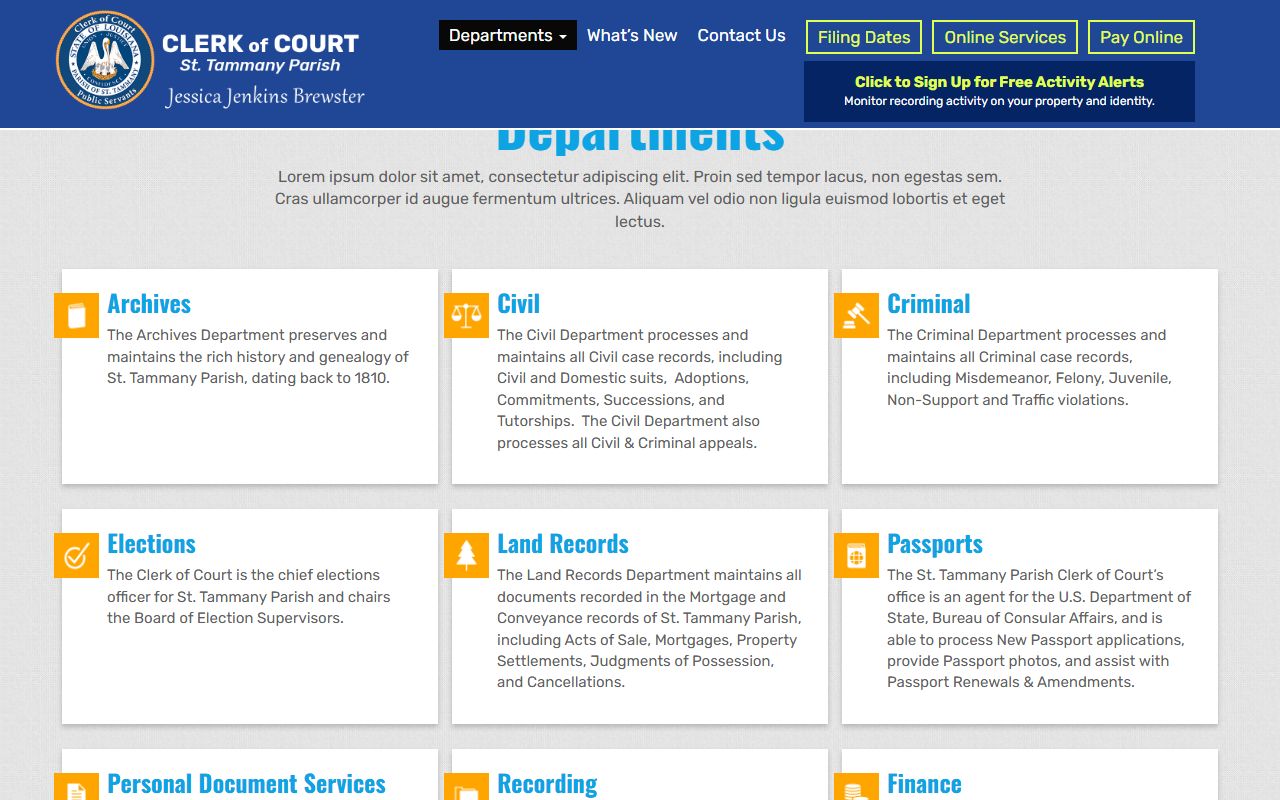
From that index you can reach the marriage-license page for the current fee, hours, and identification rules.
St. Tammany Parish Marriage License Application Fields
The marriage license application collects identity and eligibility details for both applicants. Some fields, like Social Security number, are collected but not made public. Confirm the exact fields on the Clerk's current form before you apply.
| Field Label | Type | Required | Notes / Format |
|---|---|---|---|
| Applicant full legal name | Text | Yes | As shown on identification. |
| Date of birth | Date | Yes | Age eligibility applies. |
| Place of birth | Text | Likely | Common license field. |
| Prior marriage information | Text | Conditional | Divorce or death details may be required. |
| Identification | Dropdown | Yes | Driver license, state ID, or passport. |
| Signature / oath | Signature | Yes | Applicants sign under penalty rules. |
Certified St. Tammany Parish Marriage Copies
After the marriage is recorded, the Clerk can provide certified copies. A certified copy carries the Clerk's seal and is the version most agencies accept for a name change, a benefits claim, or proof of marriage.
Provide the names and the year of the marriage to help staff find the record. A plain copy works for personal reference, but it is not a substitute for a certified copy where one is required.
Older marriage records may need staff help or an in-person request, especially if the marriage predates the Clerk's online index. Keep the request specific, since a full legal name and a marriage year narrow the search far faster than a partial name alone.
St. Tammany Parish Divorce Records
Divorce cases are district court records filed with the Clerk in the 22nd JDC. A public index may show the case caption, the case number, the filing date, the division, and the disposition. You can search by party name or case number through the Clerk's court-record tools.
Documents that involve children, financial identifiers, domestic abuse, or sealed evaluations may be restricted or redacted. The St. Tammany Parish court records page explains the search tools in more detail.
A divorce index is not the same as the full case file. The index confirms that a divorce was filed or finalized, while the certified judgment proves the legal outcome. When you need proof for an agency or a court, the judgment is the document that counts.
What St. Tammany Parish Divorce Records Show
A public divorce index lists the basic facts of the case while keeping sensitive details private. You can usually see the parties, the case number, and the disposition. Financial affidavits, custody evaluations, and protected addresses are often sealed or redacted.
| Field | What It Shows |
|---|---|
| Case Caption | The names of the spouses, subject to redaction. |
| Case Number | The district-court identifier for the divorce. |
| Filing Date | The date the petition was filed. |
| Division | The family court division handling the case. |
| Disposition | Whether the divorce is pending or final. |
For the full judgment, request a certified copy from the Clerk rather than relying on the index entry alone.
How to File for Divorce in the 22nd JDC
A divorce in St. Tammany Parish is filed with the Clerk and heard in district court. Louisiana sets residency, venue, and waiting or separation rules, so confirm those before filing. Many people use an attorney for custody, support, or community-property issues.
- Confirm Louisiana residency and venue requirements.
- Prepare the divorce petition and any custody or support pleadings.
- File with the St. Tammany Parish Clerk of Court.
- Pay filing fees or request pauper status if eligible.
- Serve the other spouse by a lawful method.
- Observe statutory waiting or separation periods.
- Attend hearings or submit uncontested documents as required.
- Obtain certified judgment copies from the Clerk.
Certified Divorce Judgments
Certified divorce judgments come from the St. Tammany Parish Clerk of Court, not the state vital records office. Provide the case number or the party names and the filing year to speed the request. A certified judgment is often required to remarry, change a name, or settle benefits.
Note: A certified divorce judgment must come from the Clerk that holds the case, since a portal printout is not accepted as a certified record.
Sealed and Restricted Family Records
Family files carry strong privacy rules. Filings that involve minors, abuse, or financial identifiers may be sealed or redacted. Adoption records are confidential under Louisiana law and are not part of an ordinary public case search.
To view a sealed family record, a party or lawyer usually files a motion and asks the court to unseal it. Personal identifiers stay protected even when the rest of a file is open.
Fees and Vital Records
The Clerk sets the marriage-license fee and the copy and certification fees, and the amounts are listed on the Clerk fee schedule. Confirm the current marriage-license fee and accepted payment methods before you apply. Ask for an estimate if you need several certified copies.
Louisiana vital records may handle some statewide birth, death, and marriage-related services, but the parish Clerk is the source for the local marriage license and the district-court divorce judgment.
Self-Help and Legal Aid
Self-represented spouses must follow the same filing, service, and evidence rules as attorneys. For custody, support, or contested issues, legal advice is strongly recommended. Eligible low-income residents can seek help from Southeast Louisiana Legal Services, and Louisiana Law Help offers self-help information and referrals.
The Clerk can explain filing steps and fees but cannot give legal advice or prepare pleadings. For high-stakes matters like custody or community property, a short consultation with a lawyer can prevent costly mistakes that are hard to undo later.