
Louisiana Successions in St. Tammany Parish
Louisiana uses civil-law terms, so an estate case is a succession, not common-law probate. The 22nd JDC handles these matters, and the Clerk of Court keeps the filings. A succession transfers a deceased person's property to heirs or legatees and resolves debts along the way.
Succession records can include the petition to open the succession, the will, an affidavit of death and heirship, an inventory or descriptive list, the appointment of a representative, and the judgment of possession. Tutorship and interdiction filings also fall under this part of the court.
Independent administration is available in some successions, which reduces court supervision when the law allows it and the parties agree. That option can speed an estate, but it still ends with a judgment that transfers property. Whether it fits depends on the will, the heirs, and the estate's debts.
How to Search St. Tammany Parish Succession Records
Use the Clerk's court-record search and party-name search. Search by the decedent's name, the succession representative, the case number, or the filing date if the portal offers those fields. Older successions may be searched by name rather than a modern case number.
| Field Label | Type | Required | Notes / Format |
|---|---|---|---|
| Decedent / Party Name | Text | No | Search the last name and alternate spellings. |
| Case Number | Text | No | The best search method when known. |
| Filing Date Range | Date | No | Narrows older successions. |
| Case Type | Dropdown | No | Select succession or probate where available. |
The Clerk's civil department handles many succession filings and copy requests at the counter.
The Clerk's civil department page covers succession filings and court-record handling for St. Tammany Parish.
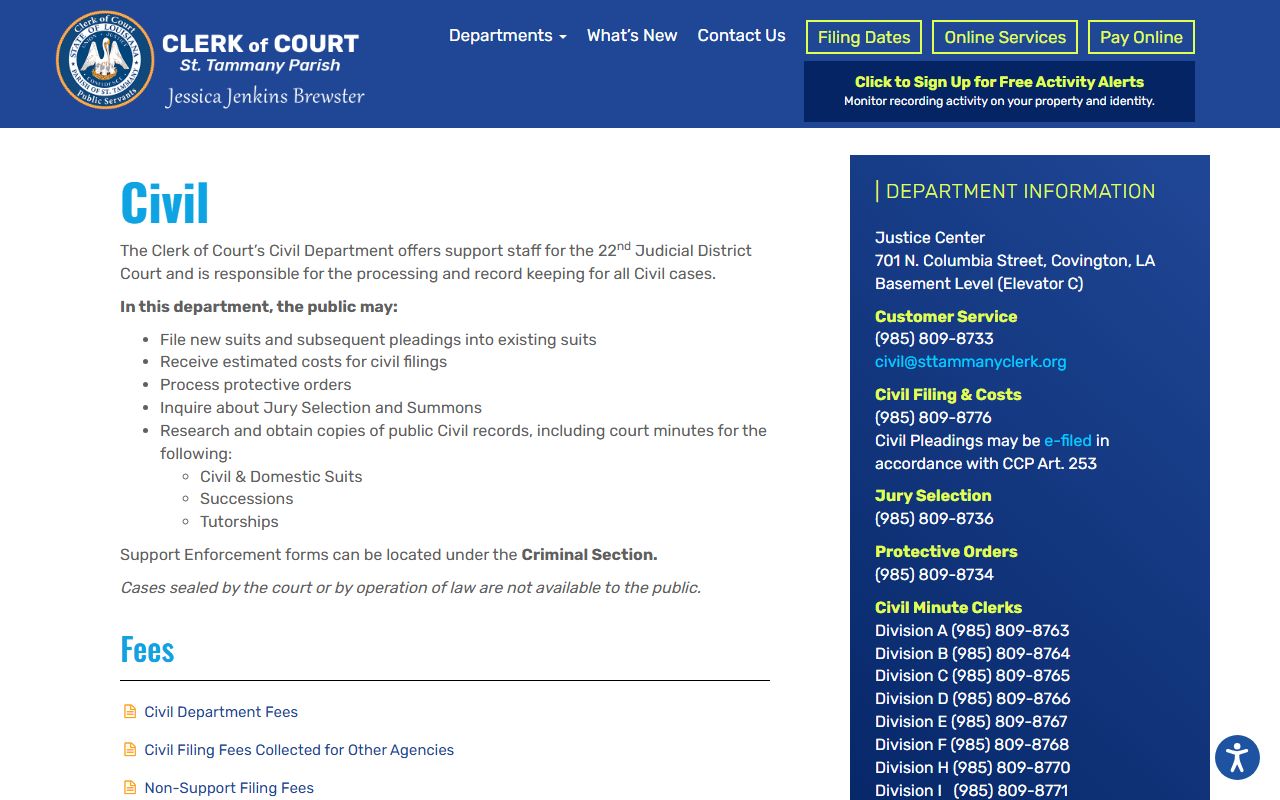
That office can confirm filing requirements and provide certified copies, though it cannot decide heirship or prepare pleadings.
What St. Tammany Parish Succession Records Show
A succession file gathers the documents that move an estate from death to distribution. The public index shows the core facts, while some exhibits stay restricted. The table lists the records you commonly find in a succession.
| Document | What It Shows |
|---|---|
| Petition to open | The request to begin the succession. |
| Will or testament | The decedent's wishes for property, where one exists. |
| Affidavit of heirship | Proof of death, domicile, and the heirs. |
| Descriptive list | The estate's property and values. |
| Judgment of possession | The order placing heirs in possession. |
Contested successions can add many motions and hearings, which lengthens the file and the timeline. A clean, uncontested succession with a clear will usually moves through faster than one with disputed heirs or out-of-state property.
How a St. Tammany Parish Succession Works
A succession follows a set sequence, though contested estates can run much longer. Some smaller estates qualify for a simplified affidavit procedure instead of a full succession. The steps below describe a typical court succession.
- Determine whether a full succession or a small succession affidavit applies.
- Gather the death certificate, the will, heir information, and property details.
- File a petition and supporting documents with the Clerk.
- Request appointment of a representative if administration is needed.
- Provide notices to creditors if required.
- File the inventory or descriptive list and resolve property issues.
- Obtain a judgment of possession transferring property to heirs.
- Record certified copies where real property is involved.
Wills and Judgments of Possession
The will, called a testament in Louisiana, names who should receive property. The judgment of possession is the court order that recognizes heirs and places them in possession. A recorded judgment of possession is often needed before heirs can sell or transfer real estate.
When real property is involved, a certified judgment must be recorded in the parish land records. The St. Tammany Parish Clerk of Court page explains land-record recording and certified copies.
Small Succession Procedure
Louisiana allows a simplified procedure for qualifying smaller estates. A small succession affidavit can transfer property when the statutory requirements are met, which avoids a full court administration. This path saves time and cost for estates that qualify.
Eligibility depends on the estate's value, the type of property, and the heirs involved, so confirm the current rules before relying on the affidavit option. Self-help forms may be available, but legal advice helps when real estate or out-of-state property is involved. The Clerk can tell you whether a filing was accepted, but the choice between a small succession and a full one is a legal call best made with a lawyer.
Tutorship and Interdiction
The same part of the court handles tutorship and interdiction. Tutorship covers the care of a minor's person or property. Interdiction is the court process for an adult who cannot care for themselves or their affairs, similar to guardianship and conservatorship in other states.
These cases can include medical and personal details, so parts of the file may be restricted even when the case exists in the public index. A petitioner usually has to show the court why the appointment is needed, and the court can require ongoing reports once a tutor or curator is named.
St. Tammany Parish Succession Terms
Louisiana succession language differs from common-law probate, and the right terms speed a search.
- Succession
- The Louisiana estate proceeding after a death.
- Judgment of possession
- The order recognizing heirs and placing them in possession.
- Succession representative
- The executor or administrator who manages the estate.
- Legatee
- A person named in a will to receive property.
- Forced heirship
- A Louisiana rule that can protect certain children or descendants.
- Descriptive list
- A sworn list of estate property and values.
Probate Fees and Certified Copies
The Clerk sets filing, copy, and certification fees for successions, and the amounts depend on the case type and the page count. Recording a judgment of possession in the land records carries its own fee based on the instrument and the number of pages. Check the Clerk fee schedule and ask for an estimate on larger files.
Certified copies come from the Clerk that holds the case. A certified judgment of possession is the document used to transfer or record property, so a plain printout is not a substitute.
Note: Family disputes, unknown heirs, missing wills, and out-of-state property can all lengthen a succession well beyond the basic timeline.
Restricted Probate Information
Most succession filings are public, but some details are not. Medical records, interdiction details, minor information, and financial identifiers may be restricted or redacted. Sealed exhibits stay out of public view unless the court allows access.
The St. Tammany Parish public records page covers Louisiana's open-records law and the limits that apply to court files.