
How to Search St. Tammany Parish Warrants
Warrant information can appear through several official channels. The Sheriff's Office is the main operational source. Criminal case dockets at the 22nd JDC show court-issued warrants like a capias. The jail booking record may list a warrant number when an arrest was made on a warrant. Use these together, since no single public list holds every warrant.
Active warrants are sometimes withheld from public view to protect investigations or officer safety. If you suspect a warrant, the safest step is to call the Sheriff's Office or speak with an attorney rather than guessing from an online search.
- Check the Sheriff's public search tools and contact the agency directly.
- Review the criminal case docket on the 22nd JDC calendar for any capias.
- Check the inmate roster to see if a booking already lists a warrant.
- Ask whether bond is set and whether self-surrender is possible.
- Confirm the warrant is recalled after the court satisfies it.
St. Tammany Parish Warrant Search Fields
Where a public warrant or case search is offered, it accepts a name, a case or docket number, or a warrant number. A name search is broad, while a case number narrows to one matter. A date range helps when you know roughly when a warrant issued.
| Field Label | Type | Required | Notes / Format |
|---|---|---|---|
| Name | Text | No | Search by last and first name where supported. |
| Case / Docket Number | Text | No | Exact number narrows to one criminal case. |
| Warrant Number | Text | No | Use if provided by the court or law enforcement. |
| Date Range | Date | No | Narrows records by date. |
| Type | Dropdown | No | Arrest, bench, civil, or capias where exposed. |
Sheriff Public Advanced Search
The Sheriff runs a public advanced search portal aimed at civil process and foreclosure matters. It is not a criminal warrant list, but it exposes case, party, address, and property fields that help users track civil matters and sheriff sales. The screenshot shows the portal's layout.
The Sheriff's public advanced search covers civil process, foreclosure, and sale filters for St. Tammany Parish.
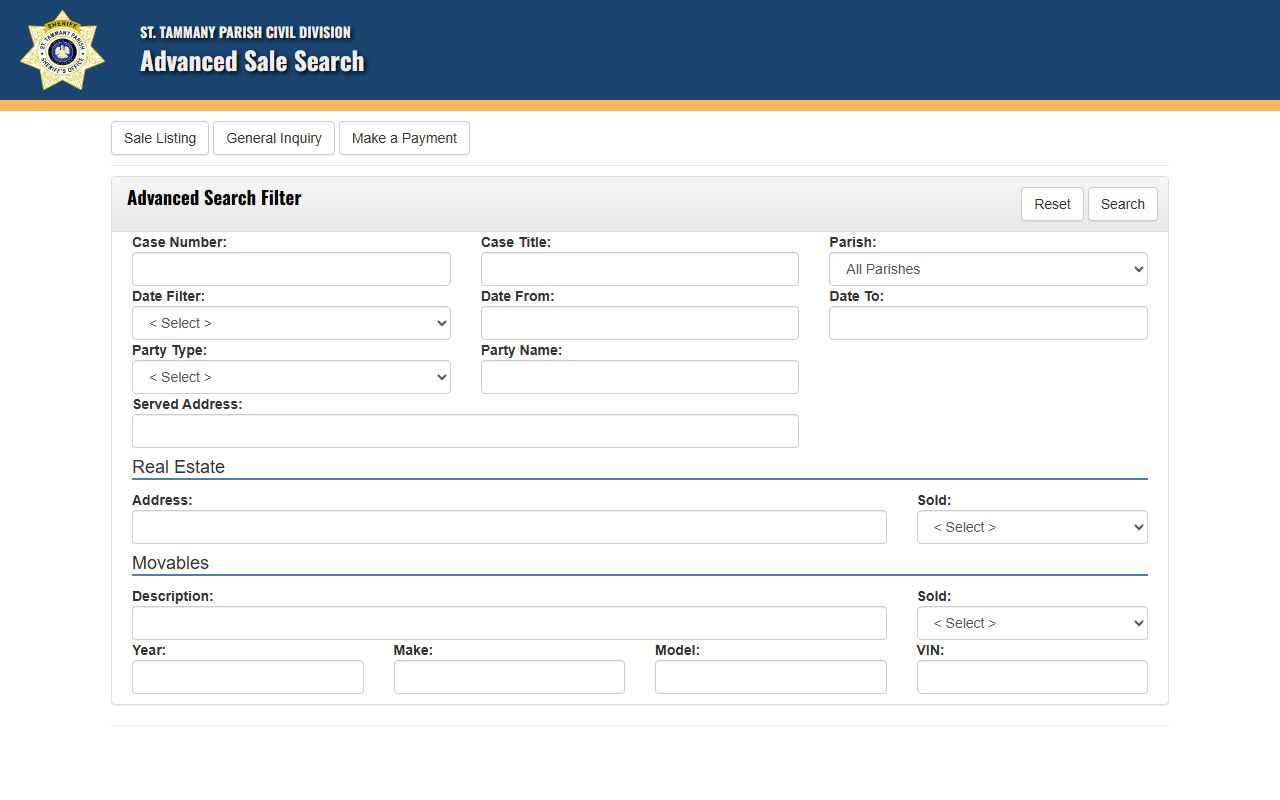
It accepts case number, case title, parish, party name, served address, and real estate fields, so it is best for civil and sale tracking rather than criminal warrant checks.
Types of St. Tammany Parish Warrants
Warrants come in several forms, and the type changes how it gets resolved. Knowing the difference helps you ask the right office the right question.
- Arrest warrant
- Issued on probable cause that a person committed an offense.
- Bench warrant
- Issued by a judge, often after a missed court date.
- Capias
- The Louisiana term for a court-ordered arrest in a pending case.
- Search warrant
- Authorizes a search; usually not public before it is executed.
- Fugitive warrant
- Tied to another jurisdiction's wanted person or an extradition.
What a St. Tammany Parish Warrant Record Shows
A warrant record, where it is public, lists the basic facts needed to identify and resolve the warrant. Exact fields depend on the source and whether the warrant is active. The list below shows the fields you would expect on a court or Sheriff warrant entry.
- Name of the person named in the warrant.
- Warrant number and the issuing court.
- Charge or reason for the warrant.
- Bond amount, if one is set.
- Issuing agency and the date issued.
- Status, such as active, recalled, or served.
No public sample warrant record was confirmed from an official St. Tammany Parish warrant list during research, so treat any field set as a guide. The Sheriff or the issuing court can verify the exact details before you act on a warrant.
Civil Writs vs Criminal Warrants
People sometimes confuse a civil writ with a criminal warrant. They are not the same. A criminal warrant authorizes an arrest. A civil writ moves a civil case forward, for example by directing service of process or a property seizure in a foreclosure. The Sheriff's civil division handles writs, while criminal warrants tie back to a criminal case.
| Point | Criminal Warrant | Civil Writ |
|---|---|---|
| Purpose | Authorize an arrest | Carry out a civil court order |
| Comes from | A criminal case or law enforcement | A civil suit or judgment |
| Handled by | Patrol and the court | Sheriff's civil division |
| Risk to person | Possible arrest | Service, seizure, or sale |
If you are unsure which one you face, the document itself and the issuing office tell you. The Sheriff's civil division can confirm a writ, while the criminal court confirms a warrant or capias.
When a Warrant Follows a Missed Court Date
The most common warrant a person runs into is a capias for a missed court date. When a defendant fails to appear, the judge can order an arrest and may forfeit any posted bond. A traffic or misdemeanor matter can spiral into added costs and a license problem if the capias sits unresolved.
The fix is usually to contact the court or counsel quickly, ask the court to recall the capias, and set a new date. Acting before an arrest gives the most options. The St. Tammany Parish court dockets page shows how to confirm a setting and avoid a missed date.
How to Resolve a St. Tammany Parish Warrant
A warrant does not go away on its own. The court that issued it must recall or satisfy it. Acting early, with legal help, usually leads to a better outcome than waiting for an arrest.
- Do not rely on a third-party warrant website for status.
- Check the Sheriff and court sources, or call the right agency.
- If the warrant follows a missed court date, review the docket and contact counsel.
- Ask whether bond is set and whether you can surrender voluntarily.
- Post bond only through official procedures.
- Confirm the warrant is cleared once the court recalls it.
Note: Avoid driving if a warrant or license issue exists, and bring identification when you address a warrant with the court or Sheriff.
Bond on St. Tammany Parish Warrants
Many warrants have a bond set, which is the amount needed for release if the person is arrested or surrenders. Bond is a release condition, not a fine or a finding of guilt. The amount can change after a first appearance, a new hold, or a judge's review.
Before posting bond, use the Sheriff's bonding information, since accepted methods and hours change. A hold from another agency can block release even after a local bond is paid. The St. Tammany Parish inmate records page covers custody status and bond in more detail.
Sheriff vs Court Data and Search Limits
The Sheriff and the court hold different pieces of the warrant picture. The Sheriff handles arrest and service. The court issues, recalls, and tracks warrants tied to cases. Public access has limits, and active warrants may not be listed online at all.
Because of those limits, treat any online result as incomplete. Confirm warrant status directly with the issuing court or the Sheriff. The St. Tammany Parish court records and arrest records pages explain how warrants connect to the case file and the booking record.